
Rhapsody Pro, Inside Out: A Factory-Floor Look at Our Own Suction Vibrator
> Read this first: Rhapsody Pro is Biozzing’s own product. We make it, we sell it on Amazon, and we earn money when you buy it. This is not an independent review and we will not pretend otherwise — no scores, no “we tested it against the competition” theater. What we can offer instead is something no third-party reviewer can: photos from the production line, the actual materials story, and a straight answer about who should buy something else. Our editorial policy explains how we label every claim on this site.
Every review site has a blind spot: the products it sells itself. Most handle that by staying quiet. We’d rather open the box completely — because I spend my working week on the manufacturing side of this industry, and the distance between what a spec sheet says and what a factory actually does is where most bad toys are born.
So this is the Rhapsody Pro with nothing airbrushed: what it is, how it’s built, what the photos show, and where its limits are.
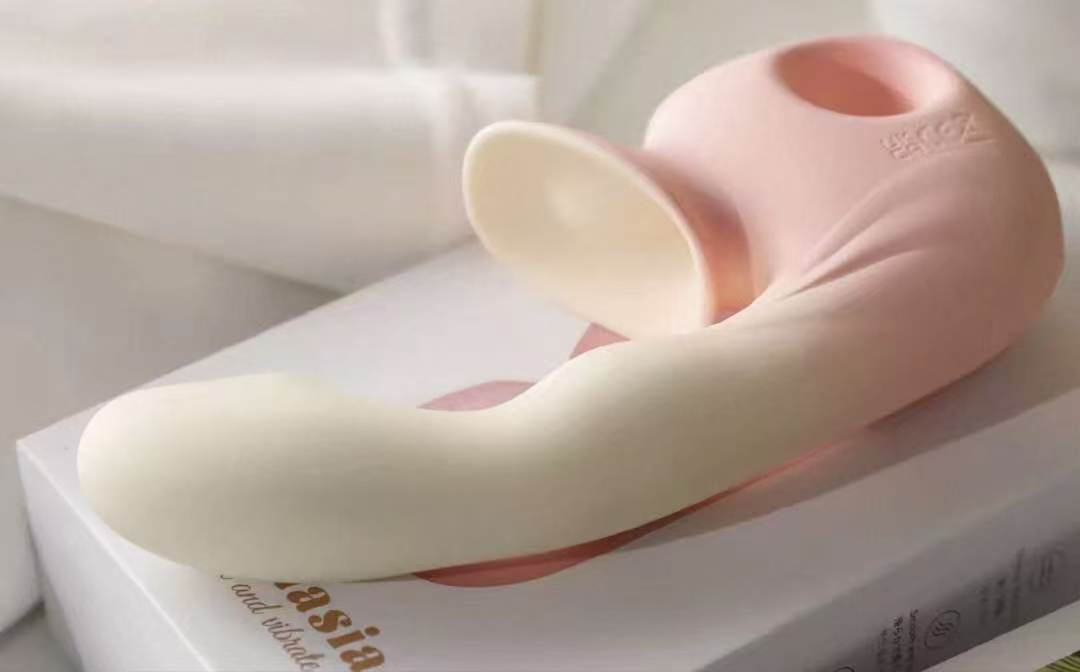
What it is, on paper
The Rhapsody Pro is a dual-action toy: an air-suction mouth on one end, a flexible vibrating arm on the other, controllable from a smartphone app. One device, both stimulation types, $69.90 on Amazon as of September 2026.
Because this is our product, every spec below is first-party. Where we have production knowledge behind a number, we say so; where a number is a lab rating we didn’t independently re-verify, we say that too.
| Spec | Value | Source note |
|---|---|---|
| Stimulation | 7 suction levels + 12 vibration patterns | first-party spec |
| Control | Smartphone app + onboard buttons | first-party spec |
| Material | Medical-grade liquid silicone (body-facing surfaces) | first-party; material grade per supplier certificate |
| Waterproofing | IPX7 (submersible) | first-party lab rating, not re-tested by editorial |
| Noise | Under 40 dB claimed | first-party lab rating, not re-tested by editorial |
| Battery | 90+ minutes per charge, magnetic charging | first-party spec |
| Warranty | 2 years | first-party policy |
| Price | $69.90 (checked Sept 2, 2026) | Amazon listing, subject to change |
The honest context: that spec combination — app control plus suction — is the reason this product exists. When we mapped the category in our app-controlled suction vibrators guide, most suction toys had no app and most app toys had no suction. Lovense closed part of that gap with the Fizz in July 2026 (our Lovense Fizz breakdown covers it), which is genuine competition and we link to it because you deserve the comparison.
What the factory photos actually show
These photos come from our manufacturing partner’s floor — production units, not renders. That distinction matters more than it sounds. Render-only listings are one of the most reliable warning signs in this category: if a seller won’t show you the real molded surface, it’s usually because the real surface has flash lines, sink marks, or a seam you’d feel.
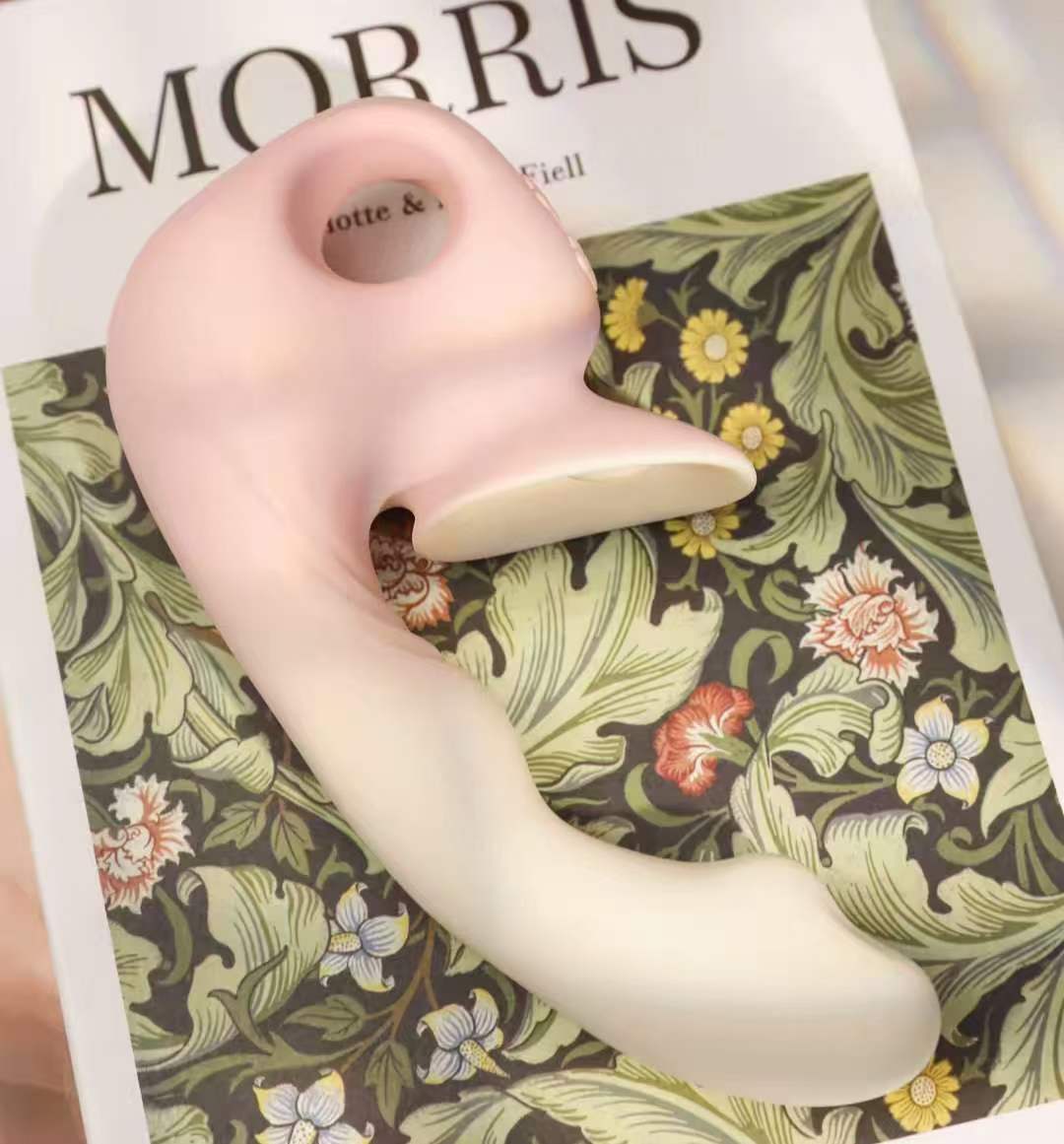
Look at the suction aperture above. Three things a production person checks in this shot:
- The rim of the suction mouth. It has to seal against skin, so any molding flash — the thin ridge left where mold halves meet — would break both comfort and suction. A clean rim like this one means the mold is being maintained, not run into the ground.
- The color transition. The pink-to-cream gradient is done in the silicone itself, not painted on. Painted coatings on a body product are a shortcut that wears off; pigmented silicone doesn’t.
- The matte surface. Liquid silicone cures with a soft, low-tack finish. A greasy shine at this stage often signals TPE being passed off as silicone — the single most common material lie in this category, and the reason we wrote our body-safe materials guide.
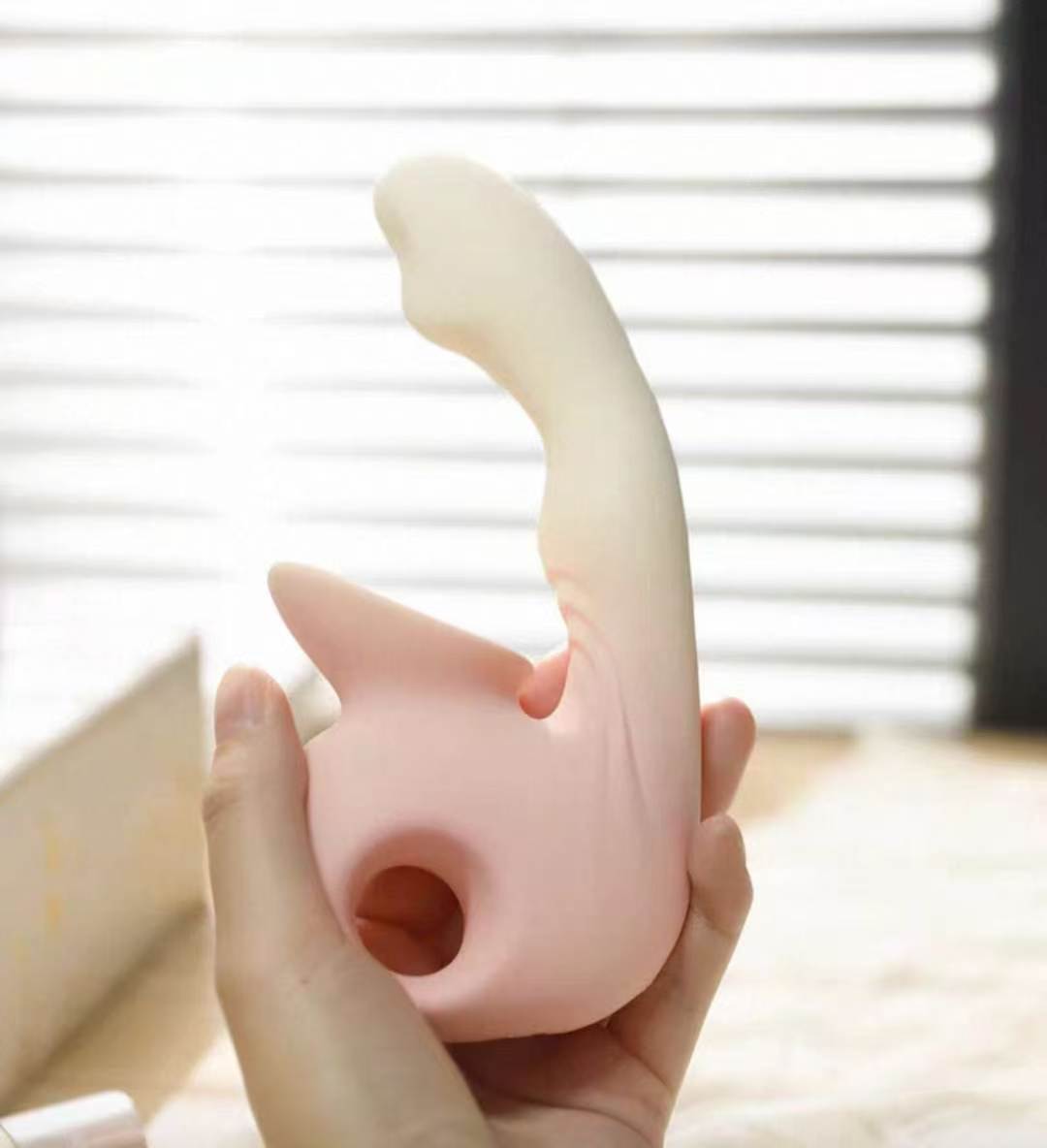
The in-hand shot answers the question spec sheets dodge: scale. The body fills a palm; the finger loop at the base is the grip. That loop is a real ergonomic decision with a real trade-off — it gives you an anchor point when hands are slippery (IPX7 exists because people use these in water), but it also adds bulk versus a slim bullet-style body. If you want something pocket-sized, this isn’t it, and our discreet vibrators roundup is a better hunting ground.
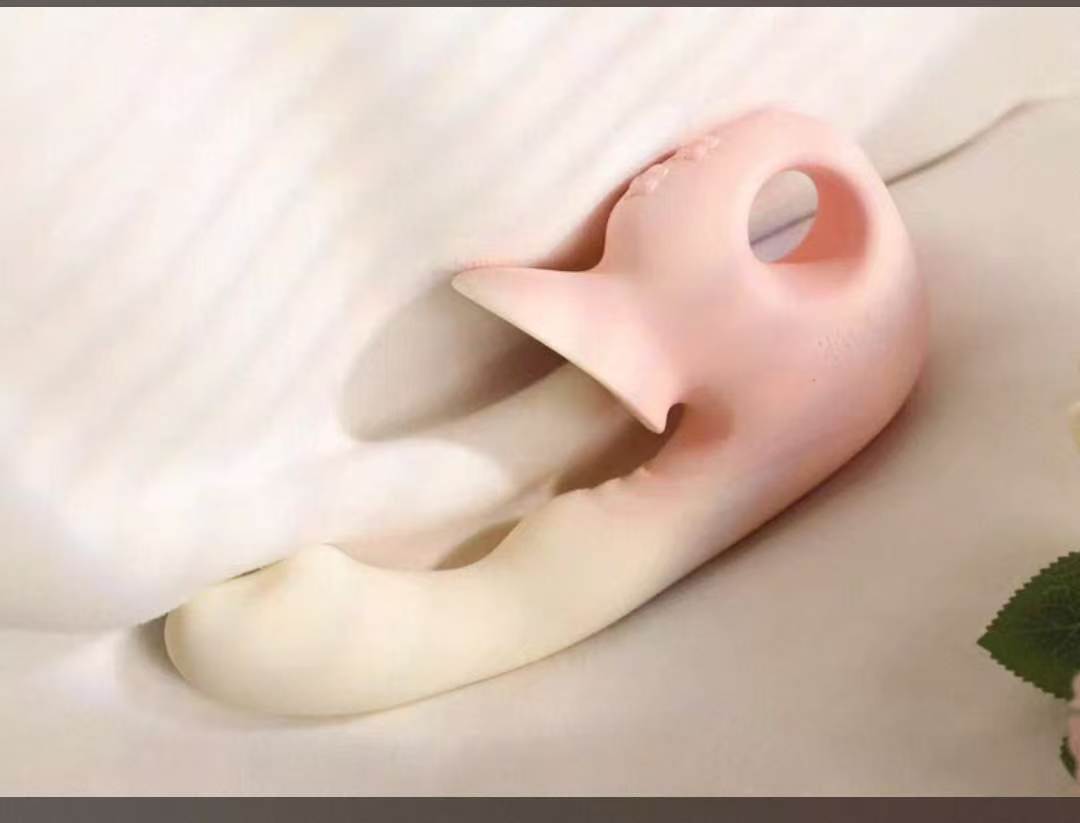
The profile view shows the second head: a curved, flexible arm carrying the vibration motor. The flex is deliberate — a rigid arm at this length would transfer every wrist angle directly into the body. The cream section bends several degrees under light pressure and returns without creasing, which is characteristic of properly cured liquid silicone at this wall thickness.
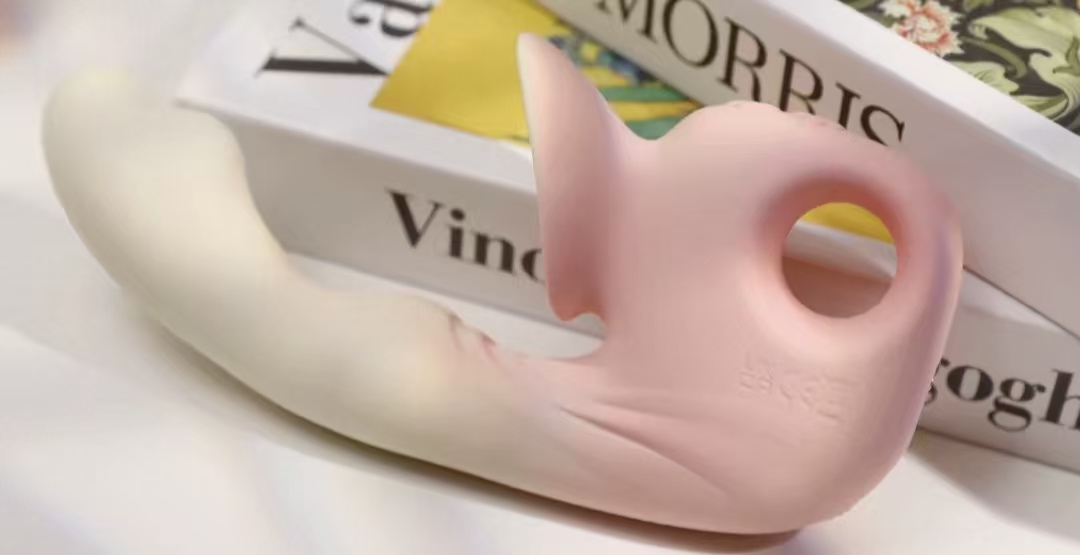
One more detail worth pointing out: the logo is embossed into the mold, not printed. Trivial cosmetically, meaningful practically — printed logos sit in ink on a surface that touches skin and gets washed with soap hundreds of times. Embossing means nothing to flake.
The materials story, without the marketing gloss
“Medical-grade liquid silicone” appears on a thousand listings. Here’s what it means when it’s true, and how the claim gets abused.
Liquid silicone rubber (LSR) is injected as two components that cure into a non-porous, hypoallergenic, phthalate-free solid. Non-porous is the part your body cares about: pores harbor bacteria that survive washing. That’s the entire case for silicone over TPE, and it’s why every cleaning guide we publish — including our suction-toy cleaning walkthrough — starts with “know your material.”
The abuse pattern: TPE blends sold as “silicone” because most buyers can’t run a flame test on a listing photo. Price is the tell. LSR molding requires steel tooling and controlled curing; genuine liquid silicone toys rarely land under roughly $25-30 retail. A $12 “medical-grade silicone” toy is, more often than not, neither.
Where does Rhapsody Pro sit? The body-facing surfaces are LSR per our supplier’s material certificate. We state that plainly and put a 2-year warranty behind it — a warranty period we chose specifically because material failures (surface degradation, seam splits) show up well inside two years of normal use.
What quality control looks like for a toy like this
From the production side, four checks matter most on a dual-motor waterproof toy, in this order:
- Seal integrity. IPX7 lives or dies at the seams and the charging interface. The magnetic charging design removes the classic failure point — a rubber port plug that loosens after fifty uses.
- Motor seating. A motor that shifts inside its cavity turns “whisper-quiet” into a rattle in three months. This is the most common cause of the noise complaints you read in one-star reviews across every brand.
- Surface finish. Covered above — flash, sink marks, coating defects.
- Battery behavior. Charge-cycle spot checks, because a battery that degrades fast is invisible at unboxing and infuriating at month four.
We’re publishing the spec claims (under 40 dB, 90+ minutes) as what they are: our numbers, from our production line’s test protocol. What we have not done is independent editorial re-testing with our own decibel meter and stopwatch — the same standard we’d demand of any brand. That re-test, with published methodology, is on our calendar; when it happens, this article gets updated with the measured numbers and a changelog, the same replacement process we committed to in our launch-week editorial framework.
The honest limitations
A first-party article earns its existence here or nowhere:
- The app is the weakest link. This is true category-wide — connectivity is the #1 complaint theme for every app toy we’ve researched, from Lovense on down — and we have no evidence ours is immune. If app control isn’t actually important to you, you’re paying for a feature you’ll use twice.
- It’s not the quietest option. Under 40 dB is a good rating, but bare motor ratings aren’t room acoustics. If absolute silence is your one non-negotiable, purpose-built quiet toys like the We-Vibe Tango X (our take, check it here) are the safer bet.
- It’s a generalist. Two stimulation types in one device means neither is the absolute best-in-class version of itself. A dedicated air-pulse specialist like the Womanizer Next (full breakdown, current price) delivers more refined suction; a dedicated wand delivers stronger vibration.
- One size, one shape. The arm’s curve fits average anatomy. Bodies aren’t average. No single-shape toy fits everyone, and any listing that claims otherwise is lying.
Who should buy it — and who shouldn’t
A reasonable fit if: you want suction and vibration in one purchase instead of two, app control matters to you (long-distance partners, pattern tinkerers), and $69.90 is your ceiling — that’s roughly half what a Lovense Fizz ($129) or Womanizer Next ($229 list) asks.
Buy something else if: you want the most refined pure suction (Womanizer’s territory — see our Next review), the deepest app ecosystem with toy-to-toy pairing (Lovense Fizz wins there), or maximum discretion in size and sound.
We link competitors with the same affiliate structure we use everywhere on this site. If you buy a Womanizer through our link instead of our own toy, we still earn a small commission — which is exactly why we can afford to tell you when the Womanizer is the right call.
FAQ
Is Rhapsody Pro made by Biozzing? Yes. It’s our own product, made with our manufacturing partner YEAIN. This page is a first-party deep-dive, not an independent review, and every spec on it is labeled accordingly.
What is the Rhapsody Pro made of? Body-facing surfaces are medical-grade liquid silicone per the supplier’s material certificate — non-porous, hypoallergenic, phthalate-free. The material background is covered in our body-safe guide.
Is it waterproof? It carries an IPX7 rating — submersible, suitable for bath and shower. That’s a lab rating from production testing, not an editorial re-test.
How much does it cost? $69.90 on Amazon as of September 2, 2026. Prices change; check the listing.
Does it ship discreetly? Yes — plain, unmarked packaging with no product description visible on the box.
What this article is, and isn’t
This is the most transparent document we can produce about a product we have a financial stake in: real production photos, labeled specs, the materials story, and a plain list of reasons to buy elsewhere. It is not a review, it carries no score, and it will never appear in our “best of” rankings — those are reserved for products we don’t sell. When our independent re-test data lands, it gets added here with dates and methodology.
If you’ve owned a Rhapsody Pro and your experience contradicts anything above, we want to hear it — that feedback goes into the next revision of this page.